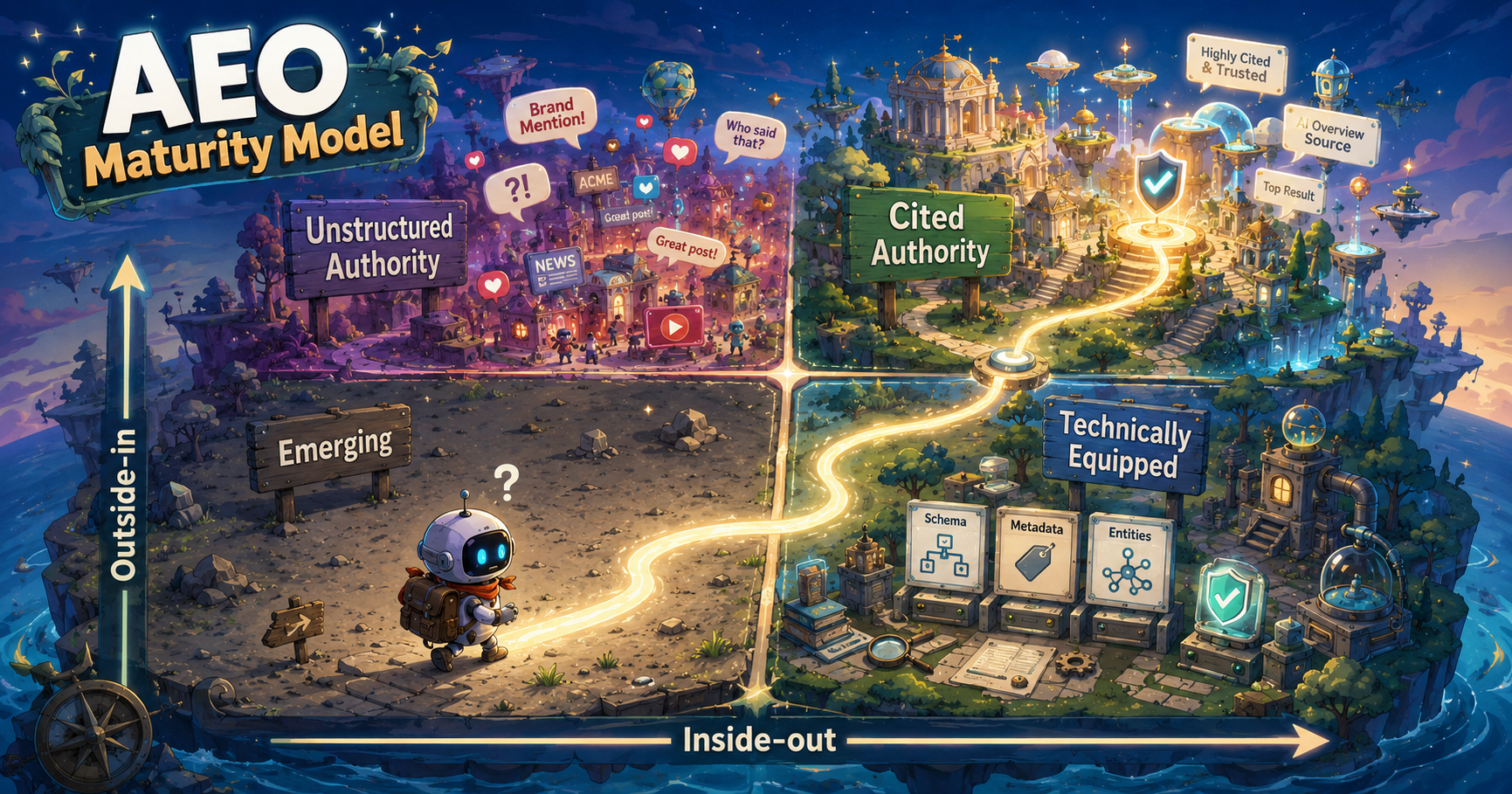


A few weeks back I published a piece introducing the AEO Maturity Model. It measures a company's AEO position on two axes: Technical Readiness, which is what your site and content make possible, and AI Visibility, which is what the models actually do with you. Establishing that baseline does two things. It gives you a way to measure progress when you invest in AEO, and it identifies the specific work in structure, content and authority signals that moves you forward.
Dave Porter raised the obvious question. How do you connect this back to leads and revenue? No CRO, CEO or CMO is going to fund AEO without knowing what it returns.
Dave's right, and I would rather concede that than defend the framework. A maturity model measures capability. It does not measure outcome, and those are different things. Dave put it better than I did: "The challenge with AEO isn't proving that AI influences buying behaviour. There is increasing evidence to suggest it does. The challenge is that much of that influence happens before a measurable click, which makes conventional attribution models fundamentally inadequate."
What I did not expect was how far past my framework the problem goes. Gartner's March 2026 Market Guide for Answer Engine Visibility Tools files attribution and revenue analytics under emerging enterprise requirements. Emerging means nobody has built it yet. The same report describes marketing leaders demanding a bridge between what it calls "dark" AI visibility, the content models use to form answers that marketers have no way to track, and revenue. They want attribution models that prove a citation leads to business value. I haven't found one that can do this convincingly.
That guide names close to fifty vendors, including one that raised $96 million in February. None of them can answer Dave's question either.
G2's 2026 research found the same thing from the practitioner side. Respondents at every stage described seeing signals that AI chatbots were influencing pipeline without being able to measure it cleanly. Several called it investing in a channel they can't yet prove.
What buyers are actually doing
There is an argument I keep hearing, and I have even made it myself. If your competitor is showing up in AI answers and you are not, your business will suffer. It sounds right. It also sounds exactly like every brand impressions argument that has ever failed to survive a budget review, and most stakeholders will treat it the same way.
So I went looking for something better than a plausible story.
Bain's zero-click research puts 85% of B2B buyers purchasing from their day one list, meaning the vendors they already had in mind before they started searching. On its own that is not news. Marketers have been making the mental availability argument for years and it has never moved a CFO.
What changes it is G2's March 2026 survey of 1,076 B2B software buyers. More than half now start research in an AI chatbot more often than in Google, up from 29% a year earlier, and 71% use one somewhere in the process. Then the two findings that matter: 69% said a chatbot surfaced information that led them to choose a different vendor than they had expected, and one in three bought from a company they had not been familiar with before.
Put those together and the day one list is no longer fixed. It gets rewritten mid-journey, by a machine, in a conversation you never see. G2's own framing is that the chatbot has become the shortlist generator, and their phrase for what buyers are doing is that they now one-shot their shortlists instead of spending weeks on research.
That is a different claim from an impressions claim. Impressions are exposure you hope compounds into preference. This is buyers reporting they bought from someone else, and naming the reason. It is closer to losing a bid than to being underexposed.
One caveat worth naming. The survey is self-reported, and buyers are unreliable narrators about what influenced them. G2 also disclosed that generative AI models were used to define the study's focus areas, optimize the survey design and analyze the results. And G2 has commercial interests here, since the same report identifies review sites as a top trust signal. None of that makes the finding wrong. If anything it points at something most B2B marketers already know: G2 reviews are among the strongest AEO assets you can own, and they are earned rather than optimized.
There is no magic formula
I went looking for one anyway. I found an article from Discovered Labs that appeared to have solved it, aimed directly at the CFO conversation, with a clean model at the center:
Projected Value = Search Volume x AI Usage % x Citation Rate x Click/Read Rate x Conversion Rate x LTV
Six variables, one number at the end. My search was over and this article was going to be much shorter.
Then I ran the numbers. Their worked example puts 120,000 monthly queries through the model at 20% AI usage, a 35% citation rate, a 1.5% click rate, 8% conversion and a $45,000 LTV. Multiply it out and you get $453,600 in monthly pipeline. The article prints $45,360.
The lead calculation has the same problem in reverse. Strip out the LTV step and the chain produces 10.08 leads per month. The article says 100. Those two numbers cannot both describe the same scenario, and the article divides the monthly fee by the larger one to arrive at a $61 cost per lead. Use the figure the formula actually returns and the cost per lead is $605, which is worse than every channel in their own comparison table, including paid social. The number carrying the entire CFO argument is off by a factor of ten in the direction that flatters the pitch.
It was published in January and updated in July. Nobody caught it, which tells you roughly how many people read an eighteen-minute ROI post closely (yes, I actually read these. Don't judge 🙂).
I would have let the arithmetic go if the foundations held, but they do not. The model asks you to believe three things:
That you can measure AI search volume for your prompt set. From what I have seen, there is no reliable, independently verifiable measure of prompt volume comparable to keyword search volume. The first term comes from keyword research tools, and prompts are not keywords, so the model's opening number is invented and everything downstream inherits it.
That you can link citation rate to click and read behavior. You can measure citation rate, and I do. What happens after a citation, inside a conversation you have no access to, is not observable.
That you can then attribute conversions and lifetime value to that traffic. You can count the clicks that make it through, and those are running at around 1% of website traffic. Nearly all the influence is zero-click, and it does not arrive with a source attached.
This is the kind of thing that gets a marketer in trouble. The author was not acting in bad faith. But a spreadsheet with six variables looks like proof, and a CFO who checks one of them will never trust the rest of your numbers again.
Your website is the wrong place to look
Every attempt at this measures the same thing, which is what happens on your site after somebody clicks. That instinct is what breaks the model, because the click is the rarest part of the whole sequence.
Conductor's 2026 AEO/GEO Benchmarks Report is the largest dataset I have found on this. They analyzed 13,770 domains and more than 3.3 billion sessions, and AI referral traffic came in at 1.08% of all website traffic, growing slowly and unevenly. One visit in a hundred.
If AEO value traveled through clicks, that number would settle the argument. AEO would be a rounding error and Dave's critique would be fatal.
But the G2 finding says 69% of buyers changed their vendor choice based on what a chatbot told them. Both of those cannot be true if the value arrives through your front door. So it does not. The influence happens inside the answer, and the buyer either arrives already decided or never arrives at all.
Conductor buries the sharpest detail in a footnote. Google Analytics classifies AI Mode, AI Overviews and organic Google traffic together, with no way to separate them. So 1.08% is a floor rather than a measurement, and the real figure is not currently measurable with conventional analytics. That is a documented limitation in the plumbing.
Their CEO, Seth Besmertnik, says it more plainly than I could, and he sells AEO software for a living: the question for 2026 is not how to grow AI referral traffic, it is how to grow brand visibility inside AI experiences. Referral traffic is a signal of where discovery is shifting rather than the goal. His company's report calls this a parallel surface of visibility, one that decides which brands appear in an answer before anyone clicks anything.
When the man selling the tools tells you to stop measuring the tool's most convenient metric, it is worth listening.
Nobody asks for the ROI on a door handle
Step back from AEO for a second and ask why we accept this demand at all.
A car company runs thousands of decisions into every vehicle. The shape of the door handle. Whether the glove box clip is metal or plastic. Where the cup holder sits. Nobody in engineering is asked to produce an attribution model for the clip. They are asked whether the car is good, whether it sells, and whether the people who buy one buy another.
Marketing is the only function where we routinely demand that each component justify itself in isolation. What is the ROI on the button color. What did the rebrand return. What is the pipeline contribution of the pricing page. These are answerable in a narrow sense and mostly not worth answering, because customers do not buy buttons or pages. They buy the whole thing, and the whole thing either works or it does not.
I am not arguing that AEO should escape scrutiny. I am arguing that the scrutiny should sit at the level where the decision actually gets made. The right question is whether your company shows up, credibly and accurately, at the moment a buyer is forming a shortlist. AEO is one of the components that determines the answer, alongside your positioning, your reviews, your documentation and everything else a model reads about you.
That reframe does not get you an attribution model. It does get you out of a conversation that was never going to produce one.
What you can do about it
Three options.
Wait.
This is the right answer for more companies than the AEO industry will admit. If the models cannot yet produce an answer a buyer would act on in your category, presence in that answer is worth very little, and the honest advice is to leave it alone and check again in six months.
You can test that in an afternoon. Write down twenty questions a real buyer would ask before shortlisting a vendor in your space. Run them across ChatGPT and Gemini, and ask three things of the output: does the model name specific vendors, are the vendors it names real and correctly described, and would a buyer plausibly act on this answer. If the models return generic advice with no companies in it, your category has not formed in the models yet and nobody is winning or losing there.
Second check, and it takes ten minutes. Type your category terms into Google and see whether an AI Overview appears at all. Conductor found the trigger rate varies enormously by sector, from 48.7% in health care down to 4.4% in real estate. If Google is not generating an answer for your category, the query class is not being treated as answerable yet.
The risk you accept is that this changes without warning. At Manta Health, ChatGPT presence moved at month four against a forecast of six to twelve. When it turns, it turns faster than a content program can respond.
Treat it as a bet.
Some leaders will look at the G2 numbers, conclude the shortlist is being written somewhere they cannot see, and fund the work without proof. This is a defensible position and it is how most category shifts get funded early. It is also the version that gets a marketing leader fired if the CRO asks a hard question in month five and there is nothing to show. If you take this route, at least take it deliberately, name it as a bet in the room, and agree in advance what would make you stop.
Measure what is measurable and be honest about the gap.
This is where I land.
Some of it costs nothing and requires no tooling, only that you ask humans. Have your sales team log it when a prospect mentions AI research on a call, unprompted, and compare win rates on those deals against everything else. Then do proper win-loss interviews, which most B2B companies should be running anyway, and add one question: how did this vendor set come together. A person will tell you in conversation what they will never tell a dropdown. Neither of those is attribution. Both are first-party evidence, and within a quarter you have your own data rather than someone else's benchmark.
The rest is the maturity model, used for what it is. Technical Readiness tells you whether the machine can read you. AI Visibility tells you whether it currently does. Both are leading indicators, both move before revenue does, and both are things you control. Track them over time, treat movement as progress on the input, and say so out loud. A CFO can work with an honest leading indicator. What loses them is a lagging indicator dressed up as a causal one.
There is a third thing worth checking that has nothing to do with pipeline. Ask the models what your company does and read the answer. If it is wrong, if it describes a competitor, if it confuses you with a similarly named business, that is a problem you can see and fix without any attribution debate at all. We found exactly that at Manta Health, where another entity with the same name was ranking ahead of them. Nobody asks for the ROI on correcting a false statement about your own product.
What would actually settle this
None of the above is proof, and I would rather say that than pretend otherwise.
What would settle it is a category measured repeatedly. Score every vendor in a market on AI visibility, wait six months, score them again, and compare the ones whose visibility moved against the ones whose did not, using outcomes you can observe from outside: review velocity, headcount, funding, analyst inclusion. That is not a controlled experiment, and I would not claim it was. It is closer to evidence than anything currently published.
The reason nobody has done it is structural. Gartner's guide lists close to fifty vendors in this space, and every one of them sells to the companies they would have to rank. Publishing a neutral scorecard of your own customers is not a business anyone wants to be in.
I am looking at building it for selected industries, possibly CAD or MES. If I do, the methodology will be public, including the parts that do not work, and if the first wave shows no relationship between visibility and anything commercial I will publish that too.
The ROI model is not coming this year, possibly not next, and the companies that wait for it will be waiting from outside the answer while somebody else gets named in it.
The work itself is not speculative. Clear messaging, accurate information about your company in the places models read, documentation a machine can parse, reviews you earned rather than gamed. That was worth doing before any of this, and it stays worth doing if the models change their minds tomorrow. What has changed is the cost of being unclear. There is now a system reading everything written about you and summarizing it for your buyer in three sentences, and it does that whether or not you participate.
Measure what you can, label it honestly, and get on with it.
References
Bain & Company. Losing Control: How Zero-Click Search Affects B2B Marketers.
Conductor. The 2026 AEO / GEO Benchmarks Report.
Discovered Labs. ROI Calculation & Business Case: Justifying AEO Investment to Your CFO. January 2026.
G2. The Answer Economy: 2026 AI Search Insight Report. March 2026. Survey of 1,076 B2B software buyers and decision-makers.
Gartner. Market Guide for Answer Engine Visibility Tools. Noam Dorros, Isoke Mitchell, Serena Philip. 9 March 2026.
Further Reading
Amsive. Does LLM Traffic Convert Better Than Organic? A New Data-Backed Study. Statistical analysis of 54 websites finding no significant conversion difference between LLM and organic referral traffic.
Bain & Company. The Marketing-Finance Divide Is About Proof of Performance, Not Priorities.
Seer Interactive. AIO Impact on Google CTR: 2026 Update. 53 brands, 5.47 million queries, fourteen months.